


Blog
Fire Safety Standards for Carpets

Fire Safety Standards for Carpets
Why Fire Safety Matters for Commercial Carpets
Carpets used in commercial interiors must meet safety requirements that help limit the spread of fire and smoke. Fire testing evaluates how materials react when exposed to flame or heat.
These tests help architects, designers, and building managers ensure that flooring materials meet the safety expectations of commercial environments.
Common Fire Testing Standards for Carpets
Several international testing standards evaluate the fire performance of carpets used in commercial spaces.
ASTM E648 – Critical Radiant Flux Test
This test measures how well a carpet resists flame spread when exposed to a radiant heat source. It is widely used for carpets installed in commercial buildings and public spaces.
ASTM E84 – Surface Burning Characteristics
This test evaluates flame spread and smoke development of materials when exposed to fire conditions within a controlled environment.
ISO 9239 – Reaction to Fire Tests for Floorings
This international standard measures how flooring materials behave when exposed to heat and flame.
Fire Safety Considerations for Office Carpets
When selecting carpets for commercial offices, designers typically consider several safety factors.
- Material composition and fibre type
- Density and construction of the carpet
- Fire testing certifications where applicable
- Installation environment and building regulations
- Compatibility with commercial safety requirements
Global Fire Testing Standards and Safety Compliance for Commercial Carpeting
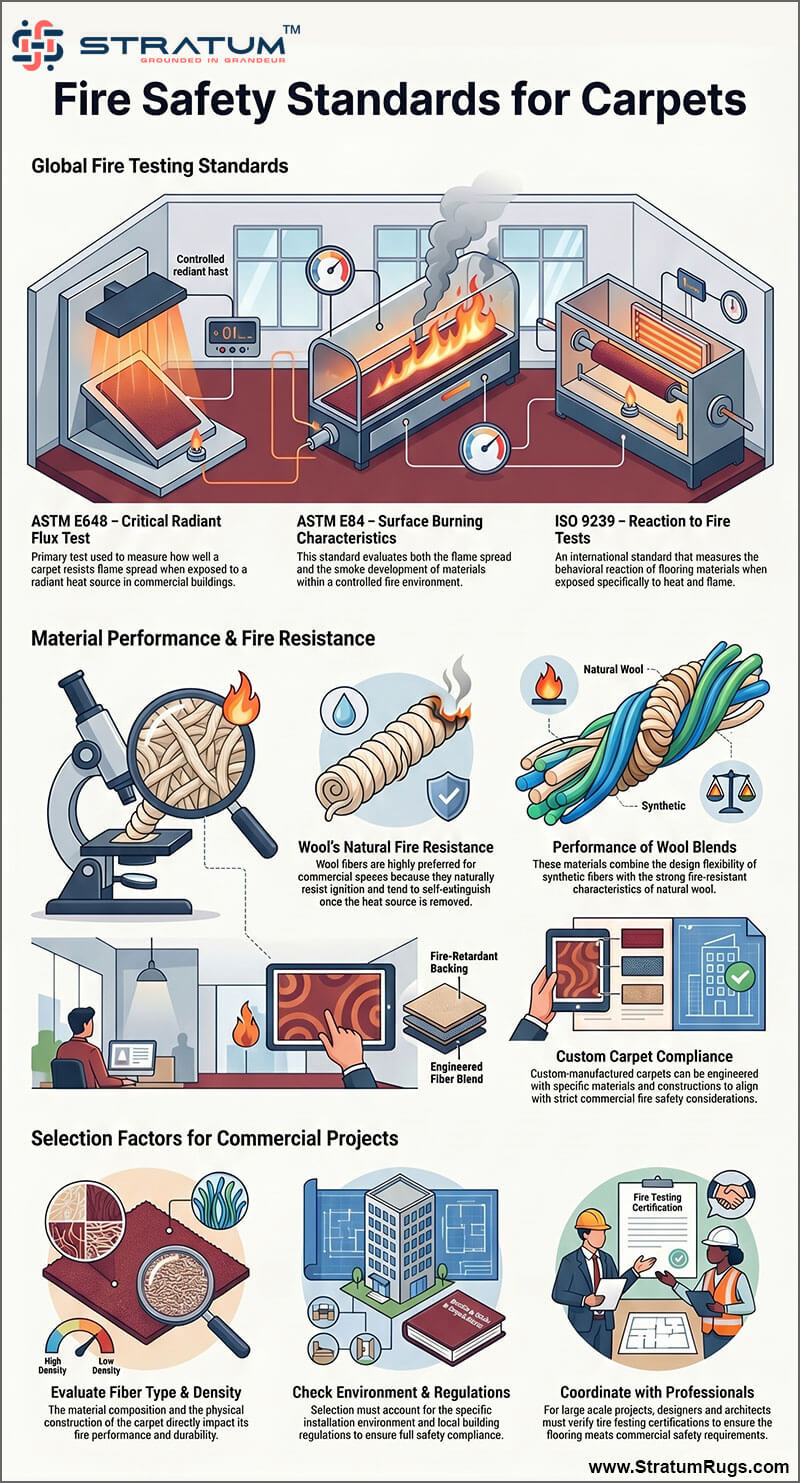
Beyond aesthetics, carpets must meet rigorous global fire testing standards like ASTM E648 and ISO 9239.
Materials and Fire Performance
Different carpet materials react differently to heat and flame.
Wool Carpets
Wool fibres naturally resist ignition and tend to self-extinguish when the heat source is removed. This makes wool carpets a preferred material for many commercial environments.
Wool Blends
Wool blends combine durability with design flexibility while maintaining strong fire resistance characteristics.
Working with Architects and Project Consultants
For large commercial projects, carpet selection is often coordinated with architects, interior designers, and facility planners. Fire performance, durability, and design requirements are considered together to ensure the flooring solution meets the needs of the space.
Fire Safety Standards for Carpets – FAQs
Why are fire safety standards important for commercial carpets?
Fire safety standards help evaluate how carpets react to flame exposure and heat. These tests help ensure flooring materials meet safety expectations for commercial buildings.
Which fire safety tests are commonly used for carpets?
Common standards include ASTM E648, ASTM E84, and ISO 9239, which evaluate flame spread and fire performance of flooring materials.
Are wool carpets fire resistant?
Wool fibres naturally resist ignition and often self-extinguish when the heat source is removed, making them suitable for many commercial environments.
Do office carpets need fire safety certification?
For many commercial projects, architects and building regulations may require carpets to meet specific fire testing standards depending on the building type and location.
Can custom carpets meet commercial fire safety standards?
Yes. Custom carpets can be manufactured using materials and constructions that align with fire safety considerations required for commercial environments.